



Inclusive Hiring in Practice
Most organisations believe they hire fairly. Yet bias still enters the recruitment process long before decisions feel intentional.
Inclusive hiring is often talked about. Far less often is it designed properly.
Most organisations believe they hire fairly. Yet bias still enters recruitment long before decisions feel intentional. It shows up in job descriptions that quietly narrow who applies, CV screening that rewards familiarity over capability, interviews driven by gut feel, and salary conversations shaped by confidence rather than consistency.
That's why QXi brought the business together, in partnership with our client, Swift, to take an honest look at where bias enters our own hiring processes and what we can realistically do to reduce it across every touchpoint in our teams.
This whitepaper captures the outcomes of that conversation. Not theory. Not aspiration. Practical actions that improve fairness and hiring quality at the same time.
Inclusive hiring is not just a values exercise.
Research consistently shows that inclusive teams outperform, innovate more effectively and retain talent for longer. Candidates expect fairness and transparency. Employees stay where they feel respected and included.
Despite this, many hiring processes still rely on subjective judgement, inconsistent assessment and unspoken assumptions about what “good” looks like.
QXi ran this workshop to challenge that. We wanted to identify where structure was missing, where bias could creep in unintentionally, and how small changes could create better outcomes for candidates and hiring teams alike.

Delivered in Partnership
The workshop was delivered in partnership with Swift, a global, member-owned cooperative and the world’s leading provider of secure financial messaging services.
Swift operates at global scale across diverse markets and cultures. That reality demands hiring systems that are fair, repeatable and robust. Their experience grounded the session in what inclusive hiring looks like when consistency actually matters.
The workshop was also supported by QXempowHERed, QXi’s internal platform created to champion equity, confidence and representation across the group.
We focused on four areas.
Rather than treating inclusion as a single moment, the workshop explored the full recruitment lifecycle and the points where bias most often appears.
Job descriptions
The language and structure of a role determine who feels welcome to apply. Overloaded requirements, exclusionary phrases and a lack of transparency narrow talent pools before hiring even begins.
CV screening
Bias often enters early through names, education, career paths or assumptions about experience. Without structure, screening decisions become inconsistent and hard to justify.
Interviews
Unstructured interviews reward confidence and familiarity rather than capability. Candidates are assessed differently, questions vary, and decisions rely too heavily on personal impression.
Salary conversations
Pay gaps are reinforced when negotiation is inconsistent and salary ranges are unclear. Equity requires clarity, not negotiation strength.
Why inclusive hiring works.
Inclusive hiring does not lower standards. It raises them.
Fair, structured processes allow more candidates to compete on what matters. Skills. Capability. Potential.
When hiring decisions are consistent and transparent, teams perform better, engagement increases and trust improves. Inclusion becomes a habit, not a policy.
This whitepaper shows how small, deliberate changes across hiring can produce meaningful impact for both candidates and organisations.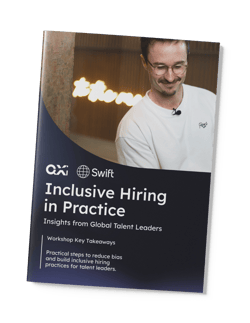
Download the Key Takeaways
This whitepaper highlights practical insights from our workshop with Swift to be applied to any business, by any leader, including:
- How unconscious bias influences decisions before we realise it
- Simple ways to design job descriptions that widen access rather than restrict it
- How structured CV screening reduces subjective judgement
- Why predictable, competency-based interviews lead to fairer outcomes
- How salary transparency supports trust and pay equity
You will also find practical ideas that can be applied immediately, including templates, frameworks and behavioural checks that reduce bias without adding complexity.
Whether you hire occasionally or at scale, the principles inside will help you make better decisions and build stronger teams. Fill in the short form below to download yours.
The best people in technology. QXi provides a platform for career growth. We champion uniqueness and unite our people through their common goals and values.